What is ALM in Fabric?

As someone who’s worked with data for over 20 years and with many cloud platforms, my main focus has always been on helping teams streamline their development process. A key area of my expertise is mentoring engineers to adopt DevOps principles to optimise workflows, automate infrastructure provisioning, and deliver value to clients more efficiently. With Microsoft Fabric’s Git integration, this opens up a powerful chapter for teams looking to enhance their DevOps capabilities. But it’s not just about adding Git; it’s about leveraging Microsoft Fabric’s lifecycle management tools to bring real, measurable improvements in how we deliver software.

Lifecycle Management in Microsoft Fabric

One of the standout features in Microsoft Fabric is its comprehensive lifecycle management tools. These tools provide a standardised approach for communication and collaboration across all members of a development team. This is crucial because it ensures that everyone, from developers to operations teams, is on the same page throughout the lifecycle of a product. Effective lifecycle management accelerates the process of getting new features and bug fixes into production, creating an ongoing flow of improvements without bottlenecks.

The beauty of lifecycle management in Fabric lies in its two key components: Git Integration and Deployment Pipelines. By integrating Fabric’s Git-based workspace updates, your teams can automate the build, test, and release pipelines to ensure that your development cycles are faster, more reliable, and less prone to human error. This makes it easier to deliver new content to production quickly, whether it’s a bug fix, a security patch, or a shiny new feature that adds value to the end users. Git integration plays a central role here, allowing seamless version control and collaboration, enabling developers to work on different features concurrently without stepping on each other’s toes.
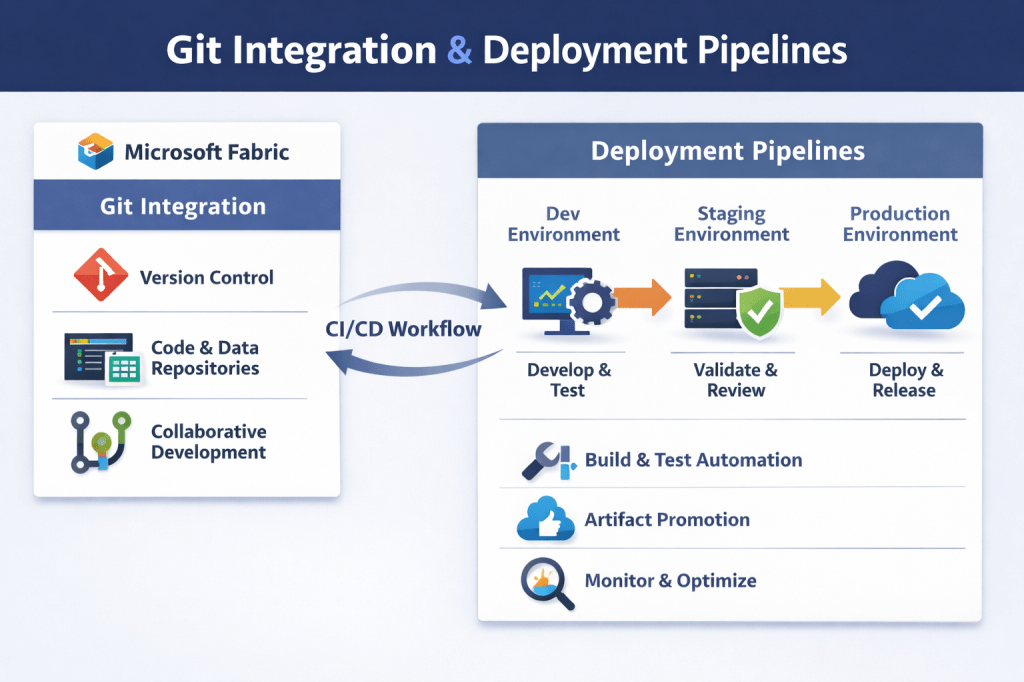

DevOps in Fabric: The Missing Piece

Now that Microsoft Fabric has Git integration, we can start applying true DevOps principles within the platform. DevOps isn’t just about automating processes—it’s about fostering collaboration, improving communication, and breaking down silos. As I work with teams, one of the first things I do is help them understand how automation and lifecycle management can be paired with DevOps practices to create a more efficient and cohesive workflow.

Mentoring engineers is one of the most rewarding aspects of my role. I work closely with teams to automate secure code builds and the infrastructure that provisions those builds. This enables development teams to focus more on coding and less on worrying about the underlying infrastructure. In a Microsoft Fabric environment, this could mean automating the deployment of entire data pipelines or deploying updates to dashboards and reports with minimal manual intervention. By streamlining these processes, development teams can release new features or updates much more quickly, which is a key tenet of both DevOps and successful software development in general.

Helping Clients Realise Value

Ultimately, the goal of applying DevOps principles to cloud platforms like Microsoft Fabric is to help my clients deliver more value to their customers. Through optimising tooling, refining delivery processes, and looking for better ways for teams to work together, I help businesses improve not just their speed of delivery but also the quality of the product. Whether it’s reducing the risk of deployment failures or ensuring that the infrastructure is cost-effective and scalable, the right approach to lifecycle management in Fabric can make all the difference.

In short, with Git integration now a part of Microsoft Fabric, it’s easier than ever to put DevOps practices into action. By leveraging the platform’s lifecycle management tools and automating infrastructure provisioning, we can help our clients unlock the full potential of Fabric, delivering better software faster and with more confidence. That’s what excites me about the future of DevOps in this space, and it’s what I’m looking forward to helping my clients achieve in the months and years ahead. 

Extended Reading

DevOps in Microsoft Fabric isn’t just about turning on Git—it’s about understanding how lifecycle management, pairing, and deployment pipelines work together. Here are some articles if you want to see exactly how to configure these features to put your ideas into reality.

What is application lifecycle management in Microsoft Fabric?

Application lifecycle management in Fabric

Get started with Git integration

Goals for 2024

Way back in 2019 I set some goals…. well I wrote some goals and posted them here

2019 seems a lifetime ago…..that was the year I travelled 200,000 air kilometres (about 125,000 air miles) helping communities learn, I helped a community that was grieving here in Christchurch, ran for the PASS Board, established my first foundational client, wasn’t scared of a cough and paid my mortgage off. Oh and I was married, but that’s a whole different story.

Fast forward 5.25 years and here I am, about to write about goals again. Now that doesn’t mean that I have not had goals in that time – one of my goals of 2021 was to survive a messy divorce and live for my kids every day. My goal for 2022 was to rebuild my life and establish my new home base. My goals for 2023 were to accelerate what I was doing and go forward at a frenetic pace that is how I live life. This involved setting up my company as a Professional Services company with consultants working through it, rather than just me doing keyboard things.

In 2024 my initial vision for this year was to innovate – whilst still maintaining my life based around my children, helping mates out with work stuff, doing great community things and enjoying great food/wine.

So here are my goals for 2024 – a year that I hope will encompass diversification of what I do in industry while maintaining good stable financial outcomes (that sounds wordy doesn’t it… I used my words carefully).

My strategic goals for 2024 are around FinOps, Real-Time Analytics, DevOps, and Artificial Intelligence (AI) which I hope will significantly enhance my company’s (Morph iT Limited) efficiency, innovation, and competitive edge….. or maybe I establish an awesome start-up dedicated to all these things (more on that in another post). Why real-time analytics you might be asking…

…..well, I am a Data Platform MVP with Microsoft and data is core to everything I have done in the past 25 years.

FinOps Goals

I want to help companies realise these benefits:

  1. Cost Optimization and Transparency: Implement comprehensive monitoring and reporting mechanisms to provide real-time visibility into cloud spending across different departments and projects. Help clients get a 20% reduction in unnecessary cloud expenditures through more informed decision-making (using data) and waste elimination.
  2. Cross-Functional FinOps Team: Using my existing DevOps coaching skills to write material that will help clients establish a cross-functional FinOps team that includes finance, operations, and development leaders to ensure alignment of cloud investment with business outcomes.
  3. FinOps Training and Certification: Ensure I am certified in FinOps principles by the end of June 2024 to be able to help clients embed FinOps culture deeply within their organisation.

Real-Time Analytics Goals

  1. Speak more about a Unified Data Platform: Yip, this is about Azure Data Explorer a real-time analytics platform that consolidates data across various sources, reducing the time to insight from hours to minutes. This will be around how it integrates into the Microsoft Fabric ecosystem.

DevOps Goals

These goals are more around what areas I want to focus on in 2024, you could call them trends I foresee…
I spoke about trends in these YouTube videos:

https://youtu.be/0yR0GhDv1q8
https://youtu.be/FyLVOht7T1w
https://youtu.be/L2Cy1zu-egk
  1. Growth of AI and Machine Learning in DevOps (AIOps)
    AI and machine learning will increasingly be integrated into DevOps tools and processes, enabling more sophisticated analysis of data, predictive analytics, and automation. AIOps can help teams anticipate issues, optimize performance, and automate routine tasks, leading to more proactive and intelligent operations.
  2. Emphasis on DevSecOps
    Security will continue to be a critical focus, with an emphasis on integrating security practices throughout the development lifecycle rather than treating them as an afterthought. DevSecOps practices, which incorporate security early in the development process, will become more prevalent, driven by the need to address security challenges in a more agile and efficient manner.
  3. Serverless Architectures and Functions as a Service (FaaS)
    The move towards serverless computing and FaaS is expected to accelerate, offering teams the ability to focus on coding and deploying code without worrying about the underlying infrastructure. This shift supports more scalable, cost-effective, and efficient software development and deployment processes.
  4. Infrastructure as Code (IaC) Maturity
    As organizations seek more scalable and manageable infrastructure provisioning, the use of IaC will mature and expand. Tools like Terraform and Ansible will continue to evolve, enabling more dynamic and flexible management of infrastructure, which is particularly crucial in multi-cloud and hybrid environments.
  5. Enhanced Focus on Observability
    Observability will become even more critical as systems grow more complex. The ability to monitor, log, and trace system activities in real-time allows teams to understand the health of their applications deeply and respond quickly to issues. Enhanced observability tools and practices will become a staple in DevOps toolchains.
  6. Sustainability in DevOps
    Sustainability and green computing will start to influence DevOps practices, with an increasing focus on optimizing resource usage, reducing waste, and considering the environmental impact of software development and deployment activities.

These will be core tenants of what I want to do both in the community and for clients of my company.

Artificial Intelligence Goals

  1. AI-Driven Products and Services: Launch a new product or service offering powered by AI to address customer needs and create new revenue streams.
  2. AI for Operational Excellence: Implement AI algorithms in my own activities to improve operational efficiency, such as predictive maintenance, inventory management, and demand forecasting, targeting a 30% reduction in operational costs.
  3. Ethics and Responsibility in AI: Develop and implement a comprehensive AI ethics policy to guide responsible AI development and usage within any organisation, including transparency, privacy, and fairness considerations.
  4. Upskill in AI and Machine Learning: I want to understand all things AI and machine learning fundamentals to build my own capabilities.

By focusing on these goals, I want to leverage the transformative potential of FinOps, real-time analytics, DevOps, and AI to help the corporate and educational communities realise the benefits of driving cost efficiency, operational excellence, innovation, and sustainable growth.

Sounds like some good goals to have to help #makeStuffGo….

Yip.